Showing posts with label Pavey Ark. Show all posts

Sunday, 21 July 2013

Hiking in extreme conditions.

Well, when I say extreme - I mean the most extreme the Lake District is likely to throw at you, we're not about to set off across the Sahara or the South Pole.  It was only just over three months ago that we were subjected to a deluge of late snow and now here we are in the middle of a heatwave.
Pike of Stickle - Winter

For some inexplicable reason we appear to be drawn to the Langdale Pikes in extreme weather rather like a moth to a flame.  No idea why, it just happens that way.  We've climbed them in thick mist, pouring rain, ice, snow and now temperatures of over 25C and, as we battled our way through the heat last week, it got me to thinking about the similarities between hiking in freezing snow and ice compared to hiking in searing heat.  Here's what I came up with.

Drink

In both cases you'll need plenty of fluids; in winter we pack hot flasks of tea and in summer we take as much cold water as we can carry.  The problem is that fluids are heavy so I tend to refill along the way but that presents a problem for me in either type of weather.  In snowy conditions there are, sadly, no streams of steaming hot tea, and whilst some might romantically describe the "refreshing qualities of a clear mountain stream" I'd say it's more like "mind numbingly cold and likely to set your teeth off however much Sensodyne you've brushed with."

Top: Stickle Ghyll normally. Bottom: Stickle Ghyll now.
In a heatwave the problem can be finding water full stop.  My rule has always been to fill my flask from fast moving water but last week we were hard pressed to find a stream with any water in it at all.  Stickle Ghyll was more of a "trickle Ghyll" and I had to toddle round to Bright Beck to find anything moving.  Don't underestimate how much fluid you will need on a hot hike.  We got through several litres on the fell, then a couple of pints in the Sticklebarn before spending the rest of the evening re-hydrating with water at home.

Shelter

It's not until the weather kicks off that you realise how little shelter there is on the fells.  In fact in the winter it's easier to find shelter than in the summer; ducking down behind a rock face, large boulder or summit shelter can usually get you out of the wind, but in summer you need trees and there aren't any.  Well, there are a few lower down but as you get higher up they vanish completely so finding somewhere out of the searing sun to cool down and have a break is all but impossible.

Pavey Ark and Stickle Tarn
Many's the time I've cursed the strong winds on the summits but last week I would have given anything for a gust of something cool.  There wasn't a breath of breeze, even on the top of Pike of Stickle, and not a tree for miles around.  And don't think it's just the ascent that will give you problems, our descent was by far the most punishing part of the walk and we were very glad to be back in the shade of the car park.

Footing

Now here's something that is, by and large, easier in summer than in winter, but don't get too cocky.  In winter we're expecting frozen paths and therefore tend to tread carefully, in summer the over dry rocks and gravel tracks can really catch you out.  Even Steve, who has the balance of a gazelle, was caught out several times on the track back down to the car.  Dry, dusty soled boots will slip and slide over bare rock with incredibly ease.

Wear the correct gear.
Snow and heatwaves also both make it easier to cross bogs, though there's always the hidden spot waiting to engulf the boot of the unwary hiker.  At least when that happens in summer it can be a pleasant if rather stinky accident, in the winter frozen feet are no laughing matter.

Clothing

It's crucial to get your clothing right whatever the weather.  In winter most folks will agree that it's all about layers but come the summer and all sorts of odd things happen.  Trust me, bare flesh is not a cool option on the high fells in every sense of the word.  Light, loose fitting garments, hats and plenty of sun block are the order of the day.  (And to be honest a little sun block on cold clear winter days isn't an altogether bad idea either.)

And just because it's hot that doesn't mean it's OK to hit the hills in sandals and flip flops.  Proper footwear is still essential and a decent par of boots coupled with some proper woolen socks will still let your feet breathe.  Top marks to the chap we saw descending in full length denim jeans and a long sleeved white shirt with buttons done right up to the collar; absolutely no idea how he didn't just keel over and melt.

Route
Pike of Stickle with ferocious guard sheep.

In both sets of conditions you're going to need to allow yourself extra time to complete your route, and in neither case is it a great plan to tackle anything too ambitious.  That's probably why we go back to the Langdales in extreme weather; we know the routes well and are likely to be able to keep ourselves out of trouble.  In both conditions you'll need short, regular stops but at least in the summer there'll be somewhere to sit down that won't numb your bum.

Whilst it's arguably harder to get lost in summer weather conditions be prepared for the conditions to change at a moments notice.  Clear sunny days can quickly become hazy or turn into thunder storms later in the day so make sure you have your map & compass handy.

Food
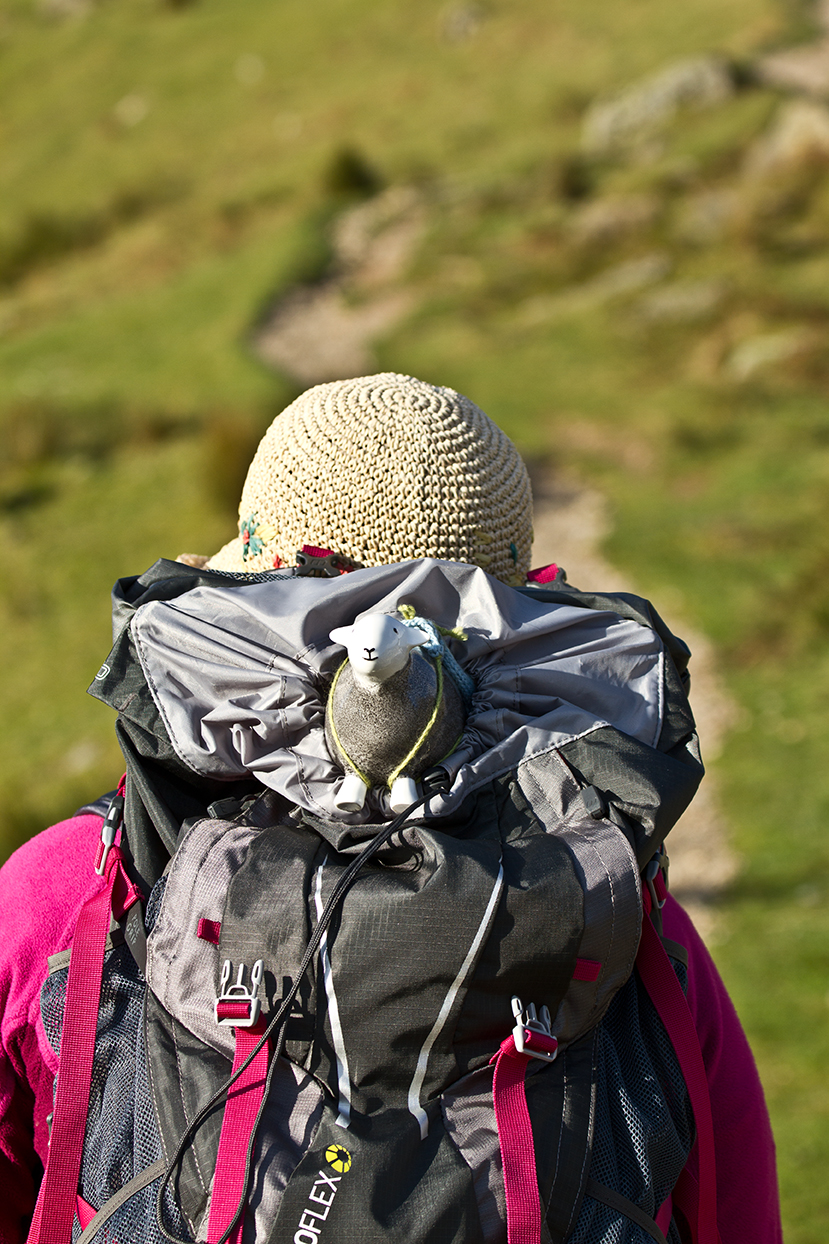
Pack plenty of food & drink but
beware of hitchhiking sheep.
Whilst the energy expended during a long hike means you can stuff yourself with calories, chocolate is a fickle companion.  We've darn near cracked our teeth on a Snickers bar in winter and if you plan on eating one during a summer hike it's best to pack a spoon.  Or a straw. Dried fruit and nuts work whatever the weather and our particular mountain snack of choice is malt loaf, especially since we discovered the banana variety.

Be careful with meaty sarnies and egg based lunch products too in the heat.  A six hour old egg butty that's rattled around in a hot rucksack all morning can knock an unsuspecting down wind hiker off their feet up to a mile away.


Off course now I've gone to the trouble of writing all of this the weather will, undoubtedly, break and for that I can only apologise.  What can I say?  Micheal Fish taught me everything I know.  Sorry.


Saturday, 30 June 2012

Not a good sign...

Pavey Ark from Stickle Tarn - Jack's Rake is the
diagonal line running up the front.
A bit of a different blog this time, prompted by a story in this week's Westmorland Gazette.  Within the space of one week, two people unfortunately lost their lives falling from Jack's Rake in Great Langdale.  These deaths are unbelievably tragic and clearly our sympathies are with their families; heaven knows how you cope when something like this happens.  In the wake of these tragedies there has been a call for warning signs to be placed on the more dangerous routes within the Lake District, and this has stirred up a bit of a hornet's nest in some quarters.

Tragic though these events are I'm afraid I'm wholly against the idea of warning signs being placed on dangerous fells for two main reasons; first of all the Lake District is a National Park and should not be cluttered up with unnecessary signage and secondly, even if there were signs I'm pretty sure people would ignore them anyway, or see it as an even greater "badge of honour" to flout the warnings.  People ignore signs every single day; "Smoking Kills", "Keep off the Grass", "No Parking" and "30MPH" to name but a few.  Signs like these are perceived as being for "other people" and not for whomever is reading them who will, no doubt, justify their reasons for ignoring them in some way or another.

Striding Edge
I've said my piece about signs before in my work blog, I genuinely think that one of the main reasons that so many signs are ignored is because there are so many of them to begin with, my previous rant was prompted by a trip to a toilet which involved 8 different signs telling me what to do.  In a society which is becoming more and more reliant upon signs to tell us what we can and can't do, we're in danger of losing the ability to think for ourselves and in the fells, that can be very dangerous.

I also think it's very important to keep things in perspective.  The second fell I ever climbed was Helvellyn and we went up via Striding Edge, another notorious route where there have been many deaths; we were pretty inexperienced but were aware of the dangers so waited for good weather and took things very steady, along with the several hundred other people on the route the same day.  Recently I was speaking with a neighbour who told me that, during one ascent of Striding Edge, his party sat and ate lunch near the final approach and counted over 1000 people going past in the space of an hour.  So let's do the maths; lets say that was an average figure for the peak ascent times of roughly 11am - 2pm, so that's 3000 people per day, now let's say there were 5 good climbing days that week, that makes 15,000 for the week and roughly 60,000 for the month.  Even if that only happened for 4 months of the year we're already getting on for nearly 1/4 million people.  (No wonder Fix the Fells are so busy!).  Tragic though it is, statistically speaking, with those kinds of numbers there will be casualties.
Sharp Edge; another notorious route.

Many moons ago my job called for me to work with TRL (Transport Research Laboratory) , these guys know all there is to know about road traffic accident and investigation and they told me that the thing they'd found which was most likely to encourage someone to reduce their speed was not a warning sign but a roadside memorial; a sharp reminder of our own mortality.  I know on our ascent of Striding Edge the memorials certainly reminded us to stay focused.  TRL were passionate about the need for appropriate signage and fully understood the problems caused by too many signs, or unclear or confusing instructions.

Warning signs appear to do very little to warn people.  Currently every car park and access point to Morecambe Bay has large warning signs regarding the dangerous sands and fast tides, and yet over one weekend in May 33 people required rescuing.  On the other side of the country, anyone who's ever visited Lindisfarne will know that every single shop, car park and tourist attraction carries warnings about the causeway and every year people ignore them and get caught out.

Following any tragic event everyone involved will look back and think how things could have been done differently, or how the same thing could be prevented from happening in the future, and it's important that we learn lessons where we can.  But the sad fact is that life is tragic. Millions of people visit the fells each year and sadly some of them get injured and a few will die.  If you stick to the safe routes you're likely to remain safe, if you tackle a more dangerous route the risk factor rises.  I'm not suggesting that the people involved in these tragedies did anything reckless or foolish, I just honestly don't think that warning signs are the answer.